Bachelor of Midwifery Science (B.Sc.)
Standard period of study: 8 semesters
Start of degree programme: Winter semester
Type of admission: Degree programme with admission requirements


As a midwife, you take on a responsible and independent role in the care of women and families during pregnancy, birth and early parenthood. The individual wishes and needs of people are always at the centre of your work.
The dual Bachelor's degree programme in Midwifery Science at the University of Lübeck offers you a practice-oriented education at the highest level. The degree programme is characterised by a continuous alternation of coordinated theoretical and practical phases. At the centre of the programme is a combination of traditional midwifery experience, scientific and evidence-based approaches and an international perspective on midwifery practice. This close interlinking opens up a wide range of prospects for your personal and professional development in a future-orientated professional field, both in Germany and worldwide.
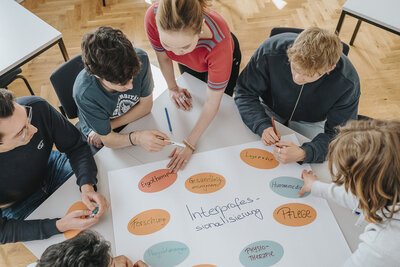
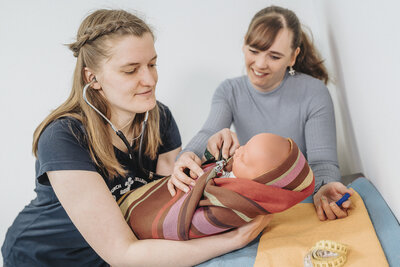
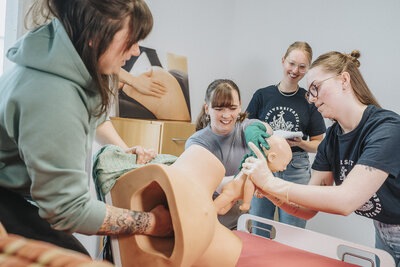
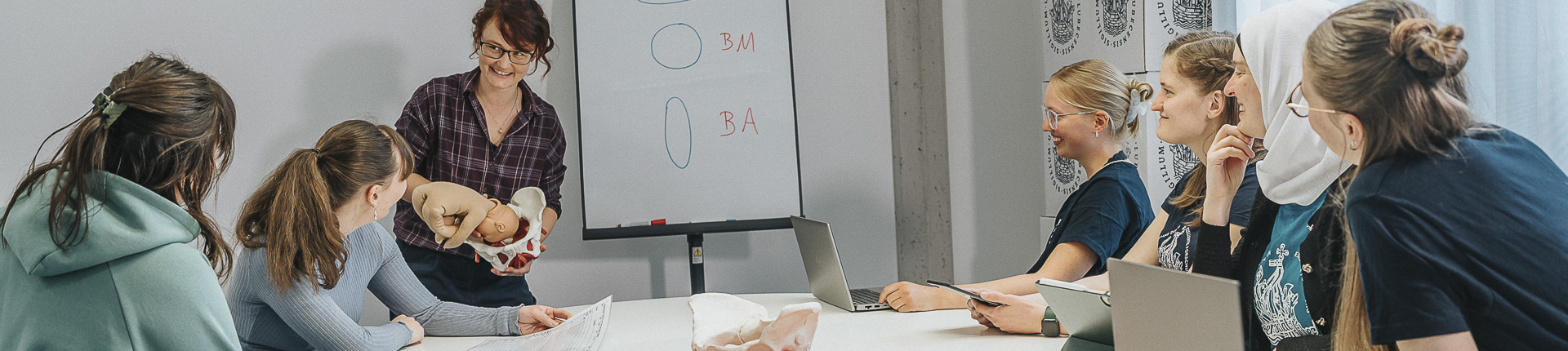
Most of the theoretical phases of your degree programme take place on the campus of the University of Lübeck. They include innovative teaching methods as well as practical simulation exercises in the new skills lab set up in 2025. For the practical phases, the university cooperates with clinics and freelance midwives throughout Schleswig-Holstein and beyond.
In addition to preparing you for the responsible work of a midwife, the degree programme places a particular focus on developing core skills that will enable you to successfully meet the changing demands of the profession. You will continuously acquire the knowledge and skills that characterise scientific, interprofessional and autonomous work as a midwife.




"The midwifery degree programme offers an individual and pleasant learning atmosphere thanks to the small number of students. The close supervision by lecturers and the cooperation with the practice centres enable practical training."
"I find it very valuable to be able to support families in such an intensive phase of life. I'm learning what for me personally is the most beautiful and at the same time most challenging profession. I learn something new every day, grow beyond my own limits and gain more and more confidence in my actions"
"As a midwifery student, I particularly like the regular and varied practical assignments. The theory is also varied and interesting. The lecturers go to great lengths to convey the knowledge in a practical way."
"It is always a great honour to accompany people in what are probably the most vulnerable stages of their lives, such as pregnancy, birth and the postpartum period. Even people living in emergency situations need support during this phase of their lives. It is therefore all the more important that UzL is increasingly drawing attention to this gap in care in the midwifery degree programme. Discrimination, exclusion and inequality of opportunity are topics that are already addressed in teaching."
Midwives are in demand all over the world because they play a central role in ensuring individual and trustworthy healthcare for women, newborns and families and save lives. Our philosophy and our craft make a real difference in the world.
If you enjoy working with people, are interested in medical and social issues, have an appreciation for diverse lifestyles and are looking for a profession that fulfills you and 'makes the world a better place' - then you've come to the right place.
Midwifery is a profession with a future. You work independently in a variety of areas and will never be bored. Furthermore, the university course offers you a pathway into research and teaching.
The study program is divided into several weeks of theory and practice phases. These alternations ensure that theoretical knowledge can be applied in practice in a timely manner and that practical experience can be reviewed and reflected upon in theory.
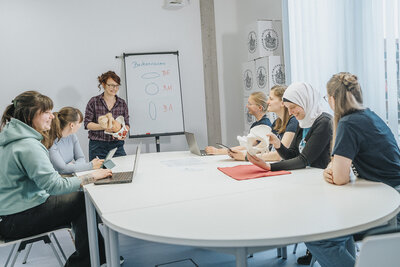
During the theoretical phases, you will attend classes on campus in Lübeck. Theoretical teaching is offered in person, but can also take place digitally or in a hybrid format. In addition, we provide you with extensive teaching materials that you can use at your own pace. Some courses are compulsory in-person, for example when you practice practical skills in the Skills Lab. For the theoretical phases, it is advisable to find accommodation in Lübeck or the surrounding area to reduce the additional burden of long commutes.
The practical phases of the program take place in a cooperating practice facility. Our cooperating practice facilities are located throughout Schleswig-Holstein (and in some cases beyond) in large and small towns; an overview can be found here. During the application process, you apply to all practice facilities that are suitable for you. During the practical phases, you will also be assigned to shift work. It is advisable to choose a practice facility that is conveniently located for you.
Many of our students live in the town where their practice is located. This helps to avoid time-consuming journeys, especially when working shifts. After all, if the shift starts very early in the day or only at night, it can sometimes be difficult to use public transport.
For the theoretical phases, many of our students come to live in Lübeck temporarily or travel there for individual days, a Deutschland-Semesterticket is granted for all students. Temporary living options include shared accommodation, renting a small room, short-term bookings via accommodation providers or using family networks.
It is also possible to apply for a practice house in Lübeck, which eliminates the need to change accommodation. Even though the need for flexible housing solutions is a particular challenge of the dual study program, our students manage to find flexible solutions that adapt to their own living situation.
If you are concerned about the issue of dual residences, please contact us for an individual consultation. We can also put you in touch with students so that you can exchange information first-hand.
For the theoretical phases, it is advisable to look for accommodation in Lübeck or the surrounding area in order to reduce the additional burden of long journeys. Start your search early, as the student housing market in Lübeck is unfortunately very limited. Also enquire at your (desired) practice house whether it can offer accommodation in Lübeck. As part of your studies, you will receive a Deutschland-Semesterticket (information on the AStA website) so that you can use public transport to commute without any additional financial burden. You will also receive a salary during your studies.
Yes, in a dual study program you will receive a salary throughout your studies. In the case of public employers, the salary is generally based on the collective agreement for students on a dual midwifery degree course in the public sector (TVHöD). However, the exact amount may vary depending on the employer. To find out the details of your individual salary, it is best to contact your (preferred) practice institution directly.
Details on the application process can be found under Admission requirements and application. The application period usually begins in February of the year for studies beginning in the following winter semester.
As part of the application process, you will have the opportunity to indicate your preferences for a cooperating practice institution (vPE). During the application process, you will also get to know the team at the practice institution in person, so that you can ask individual questions about the practical phases of the programme directly on site. Of course, you can also contact the programme team at any time with any questions you may have.
Several admission requirements must be met in order to apply, which can be found under Admission requirements and application. We recommend that you familiarise yourself with the admission requirements at an early stage in order to be in the best possible position when the application phase begins.
Midwifery science involves a scientific examination of practical issues. This includes, for example, reflecting on observations and actions from practice and examining whether these are compatible with the current state of research - or should be adapted. Conversely, this also means acquiring up-to-date knowledge from sources that have a trustworthy, scientific basis - and applying this knowledge in a targeted manner in practice.
Midwifery science ensures that the care of women, newborns and families in the phases of pregnancy, birth and early parenthood is always based on the current state of knowledge and is constantly evolving. As in other medical and social professions, new knowledge is added worldwide every day, so midwifery is constantly changing.
With a solid scientific education as part of your studies, you will learn the skills to access scientific knowledge and cultivate a positive attitude towards lifelong learning. You will be supported by experienced midwives who have many years of experience in research and who run active research programs.
Last but not least, the scientific orientation of the course enables you to pursue further studies, for example a Master's degree or a doctorate. Midwifery research questions often reflect the specific philosophy of midwives and are of inestimable value for the further development of high-quality, individualized and respectful obstetrics and midwifery work.
Please send all enquiries to the degree programme coordinators ("Studiengangskoordination") exclusively to the general email address: studium.hewi@uni-luebeck.de or by telephone to: 0451 3101-1853.
Please send all enquiries to the practice coordinator ("Praxiskoordination") exclusively to the general email address: hewi.praxis@uni-luebeck.de.
Please send all enquiries to the degree programme coordinators ("Studiengangskoordination") exclusively to the general email address: studium.hewi@uni-luebeck.de or by telephone to: 0451 3101-1853.
Please send all enquiries to the practice coordinator ("Praxiskoordination") exclusively to the general email address: hewi.praxis@uni-luebeck.de.
The entire team of the study programme is presented under Team Hewi.