

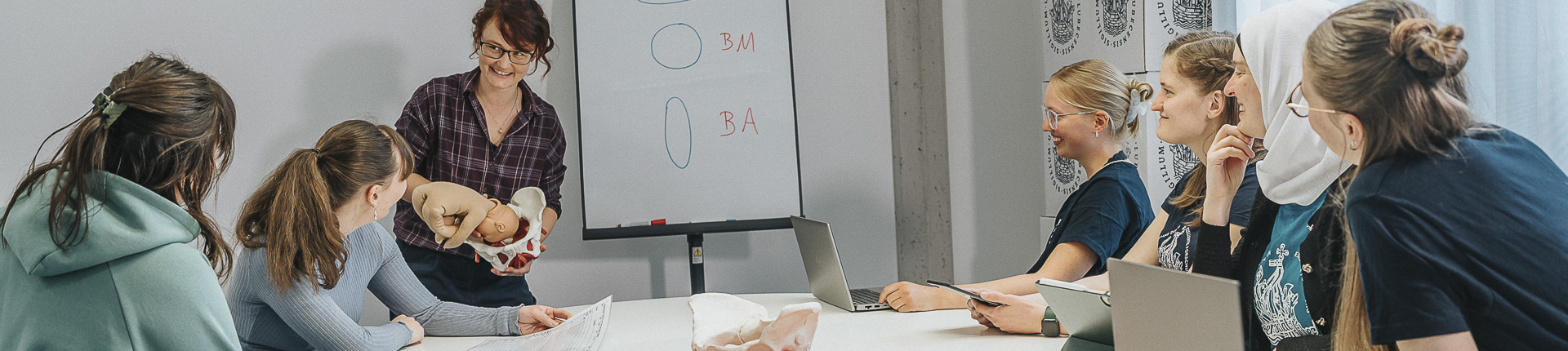
The Department of Midwifery Science is strong in research and includes projects in basic research and applied care research, as well as active promotion of young scientists. Our current research focuses on midwifery-specific topics such as physiological birth, perinatal health, innovative care models, quality assurance in studies and social justice in the healthcare system. We co-operate with partners in Germany and worldwide.





The KoHeSH project aims to improve midwifery care in Schleswig-Holstein by setting up a central coordination centre to ensure comprehensive and needs-based provision of midwifery services. The project will collect data from different perspectives, including midwives, expectant mothers and young families, in order to develop a coordination concept and a catalogue of measures to improve the working conditions of midwives in the clinical environment and to increase the quality of midwifery care. The project is funded by the Care Security Fund and is a collaboration between the University of Lübeck, the Ministry of Justice and Health and the Ministry of Social Affairs, Youth, Family, Senior Citizens, Integration and Equality in Schleswig-Holstein.
The PAUSEMATTERS study investigates natural pauses during labour and birth, so-called physiological plateaus. Such plateaus are often misinterpreted as "abnormally slow labour progress" (labour arrest), which contributes to an increased risk of unnecessary medical interventions and poorer birth outcomes.
The PAUSEMATTERS trial is crucial as it will provide high-quality scientific evidence on physiological plateaus that can help protect women from unnecessary interventions. The PAUSMATTERS study aims to strengthen the knowledge and practice of midwives, which often differs from biomedical models of thinking. The study can also help to validate midwives' experiences with high quality, robust data and provide supporting evidence for midwifery models of care (such as continuity of care in private practice) and home birth services.

Many women experience pauses or a labour progression during labour that they (or healthcare professionals) perceive as slow. We are conducting this study to understand how women experience pauses/slowdowns during labour and how this impacts on their overall birth and maternity experience.
The primary aim of this study is to explore women's experiences of physiological plateaus during labour, including how these experiences impact on access to and use of health services in Australia.
The WEPAUSE study has recently completed data collection in Australia and will soon start in Germany!
The Department of Midwifery Science co-operates closely with partners in Germany and abroad in various research projects. We are a member of the Quality Maternal and Neonatal Care (QMNC) Research Alliance, the German Society for Midwifery Science (DGHWi), the Midwifery Science Faculty Conference (HWFT) and the German Midwifery Association (DHV). In interprofessional collaboration with researchers at other universities, universities of applied sciences and in industry, we make a contribution in the key areas of perinatal health, quality in health science study programmes and social justice in healthcare.

The KoHeB project aims to improve the quality and efficiency of midwifery care in Germany by developing a comprehensive, data-driven decision support system for midwives. The project, funded by the Federal Ministry of Education and Research, will create a web-based platform that integrates high-quality, evidence-based guidelines, a knowledge database and a data archive to support midwives in their daily work. By providing easy access to relevant information and enabling data-driven decision-making, KoHeB hopes to improve the quality of midwifery care, reduce unnecessary interventions and promote a more patient-centred approach in German obstetrics.
The QMNC's Epistemic Justice in Sexual and Reproductive Health project explores how the knowledge, experiences and voices of women and marginalised groups are perceived, valued and used in sexual and reproductive health issues. The aim is to uncover epistemic injustices - situations in which certain groups of people are not recognised as credible sources of knowledge - and to develop ways to promote fair, inclusive and knowledge-based decision-making processes in the healthcare system. The project is led by the Quality Maternal and Newborn Care (QMNC) Research Alliance and takes place in collaboration with colleagues worldwide.
Doctoral, Master's and Bachelor's students are actively supported and individually supervised in the Department of Midwifery Science. The innovative research projects of our doctoral students and undergraduates make a valuable contribution to our broad research profile. Research projects by our students and doctoral candidates deal with current, diverse issues in the fields of midwifery, perinatal health and quality in health science degree programmes. A selection of current projects can be found here. If you are planning a doctorate or Master's thesis in the field of midwifery science, please contact us for an individual consultation.
(List under construction)

The blended learning format "Flipped Classroom" promotes self-directed learning processes and digital competences of teachers and students. The project identifies the needs of teachers on midwifery science/midwifery degree programmes in order to promote the implementation of "flipped classroom" concepts in the degree programmes of midwives-to-be.
More info: Heb@DigiEdu


The University of Lübeck has a clear focus on medicine and health alongside life sciences and computer science. In the area of online teaching, it is well positioned in terms of training cognitive skills. The project aims to extend this to include practical skills: The university skills labs for medicine and health are to be prepared for hybrid teaching by upgrading them with standardised hardware and software. This will make it possible to implement a wide range of hybrid teaching/learning scenarios in which students can build up their skills to a greater extent than is currently the case, both on their own and under their own guidance.
The project can build on extensive university preparatory work on both a technical and didactic level. Health is not only a central subject of research and teaching at the university, the physical and mental health of students in the learning process has long been actively promoted. However, the digital transformation of teaching is creating new risks for, but also new opportunities to promote health. The project aims to transfer existing face-to-face teaching approaches to digital and hybrid teaching/learning environments and systematically analyse their effectiveness. To this end, the existing skills labs at the University of Lübeck are to be technically and organisationally upgraded. The aim is to provide teachers and students with a standardised infrastructure that opens up a variety of new didactic possibilities and can be trained, maintained and further developed in a standardised manner.
LABORATORIUM
AI-supported individual learning assistance in the skills lab for patient-centred and interprofessional communication in the healthcare professions
With the individual application LABORATORIUM on the topic of skills labs of the future, an interdisciplinary consortium with institutes and clinics of the University of Lübeck under the umbrella of COPICOH was successful in the federal-state funding initiative "Artificial Intelligence in Higher Education".
The aim is to develop an AI-supported individual learning assistant in the skills lab for patient-centred and interprofessional communication in the healthcare professions. The project aims to improve practical training in all degree programmes in the medical section, including health sciences, through intelligent ambient learning spaces.
The following is a selection of publications from various subject areas. Publications by all members of the Department of Midwifery Science and the Institute of Health Sciences can be found here: research.uni-luebeck.de
- Weckend, M., McCullough, K., Duffield, C., Bayes, S., & Davison, C. (2025). Physiological plateaus during normal labor and birth: A novel definition. Birth, 52(1), 55-65. https://doi.org/10.1111/birt.12843
- Weckend, M., Gent, L., Godecke, E., Coventry, L., Doleman, G., Towell-Barnard, A., & Whitehead, L. (2025). Research Priorities for Nursing and Allied Health: A Priority-Setting Project Using a Partnership Approach. Journal of Advanced Nursing. Vorzeitige Online-Publikation. https://doi.org/10.1111/jan.70190
- Weckend, M., McCullough, K., Duffield, C., Bayes, S., & Davison, C. (2024). Failure to progress or just normal? A constructivist grounded theory of physiological plateaus during childbirth. Women and Birth, 37(1), 229-239. https://doi.org/10.1016/j.wombi.2023.10.003
- Mahler, J., & Stahl, K. (2023). Early labour experience questionnaire: Translation and cultural adaptation into German. Women and Birth, 36(6), 511-519. https://doi.org/10.1016/j.wombi.2023.05.003
- Stahl, K., Reisinger, A., & Groene, O. (2022). Assessing patient experience with patient safety in primary care: development and validation of the ASK-ME-questionnaire. BMJ Open, 12(4), Artikel e049237. https://doi.org/10.1136/bmjopen-2021-049237
- Voges, J. F., Müller-Pinzler, L., Neis, M., Luebber, F., Lange, T., Hundt, J. E., Kasten, M., Krämer, U. M., Krach, S., & Rademacher, L. (2022). Association of stress-related neural activity and baseline interleukin-6 plasma levels in healthy adults. Stress, 25(1), 267-275. https://doi.org/10.1080/10253890.2022.2094704
- Buchanan, K., Velandia, M., Weckend, M., & Bayes, S. (2021). Learning objectives of cultural immersion programs: A scoping review. Nurse Education Today, 100, Artikel 104832. https://doi.org/10.1016/j.nedt.2021.104832
- Stahl, K., & Agricola, C. J. (2021). Interprofessionelle Zusammenarbeit aus Sicht von Hebammen. Public Health Forum, 29(2), 166-169. https://doi.org/10.1515/pubhef-2021-0026
- LLaine, K., Yli, B. M., Cole, V., Schwarz, C., Kwee, A., Ayres-de-Campos, D., … Dadak, C. (2021). European guidelines on perinatal care- Peripartum care Episiotomy. The Journal of Maternal-Fetal & Neonatal Medicine, 35(25), 8797–8802. https://doi.org/10.1080/14767058.2021.2005022
- Weckend, M. J., Spineli, L. M., Grylka-Baeschlin, S., & Gross, M. M. (2019). Association between increased antenatal vaginal pH and preterm birth rate: A systematic review. Journal of Perinatal Medicine, 47(2), 142-151. https://doi.org/10.1515/jpm-2018-0097
- Weckend, M. J. (2019). Midwifery in Germany: Practice, education and transition for newly qualified midwives. in Starting Life as a Midwife: An International Review of Transition from Student to Practitioner (S. 107-122). Springer International Publishing AG. https://doi.org/10.1007/978-3-319-93852-3_6
- Balaam, M. C., Haith-Cooper, M., Pařízková, A., Weckend, M. J., Fleming, V., Roosalu, T., & Vržina, S. Š. (2017). A concept analysis of the term migrant women in the context of pregnancy. International Journal of Nursing Practice, 23(6). https://doi.org/10.1111/ijn.12600
- Weckend, M. (2016). Gesundheitliche und psychosoziale Hilfen bei geflüchteten Frauen und Kindern. Schriftenreihe der Stiftung Eine Chance für Kinder, 2016(14), 12-15.
- Riechmann-Wolf, M., & Stahl, K. (2015). Patientenerfahrungen und Mitarbeiterzufriedenheit - zwei Seiten einer Medaille? Gesundheitsokonomie und Qualitatsmanagement, 20(3), 127-131. https://doi.org/10.1055/s-0034-1385591